

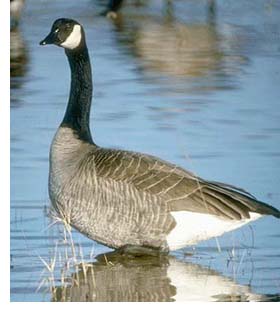
Distinguishing Features – Head and neck, black; large white patch on cheeks. The upper parts and wings are grayish-brown. Feathers tipped with browny-white. Underbody, browny-gray with pale feather tips.
Rump, slate; upper tail coverts, white; tail, black; lower belly and under tail coverts, white. Neck, long. Bill and legs, black. Male and female are essentially indistinguishable.
- Size – 55.8 – 101.6 cm
- (22.5 – 41 in)
Habitat
Around waterways and wetlands.
Nesting
On the ground, close to water, sometimes in an abandoned large nest in a tree, or an artificial platform.
A nest is a depression in the ground lined with sticks and grasses, with an inner lining of down. Eggs, 4 – 6; white. Incubation period 24 – 28 days.
Notes
The Canada Goose is a widely-recognized national symbol and is readily identified up close or flying swiftly in V-formation during migration.
Its familiar call is a harsh, nasal Ka-ronk. The diet is varied, consisting of small aquatic life and insects to plant roots and grains.